01Is LetSafe UK a firm of solicitors?
+
No. We sell self-help templates to private landlords. We are not a firm of solicitors, not a letting agent, and not an insurance provider. Template preparation is not a reserved legal activity under the Legal Services Act 2007.
02What happens on 1 May 2026?
+
Phase 1 of the Renters' Rights Act 2025 commences in England on 1 May 2026. Assured Shorthold Tenancies (including Section 21) are abolished and replaced by periodic Assured Tenancies. English ASTs in existence on 30 April convert automatically at midnight, subject to the Act's transitional provisions and excluded categories (resident landlords, lets to companies, certain student lets, holiday lets, long leases over 7 years, supported accommodation). Our Transition Pack (LS-E-130) walks you through what this means for your portfolio.
03Can I still use a Section 21 eviction notice in 2026?
+
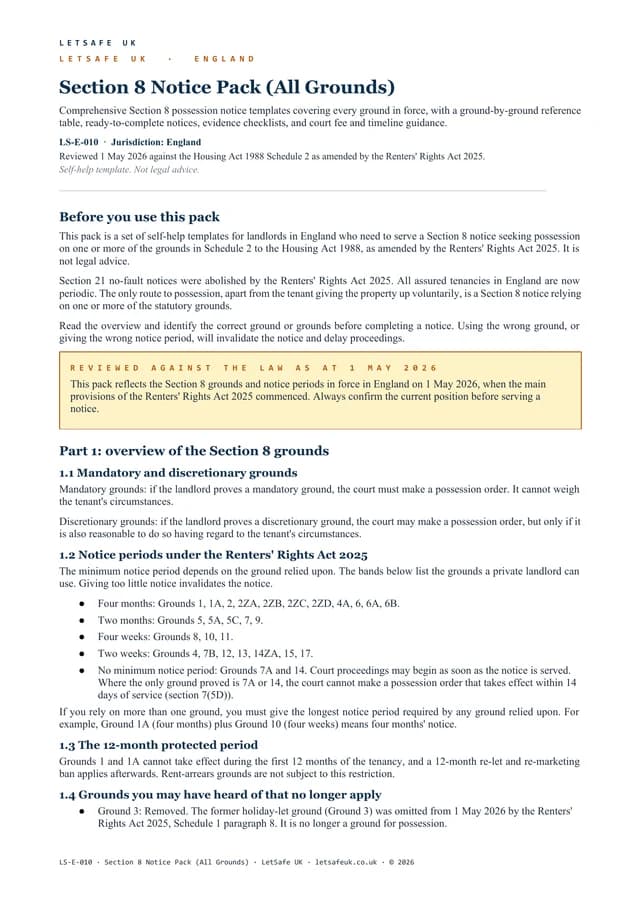
No. Section 21 is permanently abolished in England from 1 May 2026. The only way to recover possession is a Section 8 notice citing a statutory ground, such as rent arrears (Ground 8), landlord sale (Ground 1A), or anti-social behaviour (Ground 14). LetSafe UK's Section 8 Notice Pack covers every current ground, with guidance on which to use.
04What is a periodic tenancy agreement and do I need one?
+
A periodic tenancy has no fixed end date, it rolls from one rental period to the next until either party brings it to an end using the correct statutory notice. The rules differ by jurisdiction. In England, from 1 May 2026, all new private tenancies must be Periodic Assured Tenancies (PATs); fixed-term ASTs cannot be granted for new lettings after that date, and existing ASTs convert automatically at midnight on 30 April 2026 subject to the Act's exclusions. In Wales, a fixed-term standard contract does not automatically roll into a periodic standard contract in every case, a periodic contract is only created if the contract-holder remains in occupation at the end of the fixed term without a new contract being agreed; a landlord wanting to end a fixed term at its expiry must serve the prescribed notice during the fixed term (Form RHW25 for new contracts, RHW38 for converted contracts), doing nothing is not a strategy in Wales. In Scotland, Private Residential Tenancies under the 2016 Act are open-ended from day one, there are no fixed terms. In Northern Ireland, private tenancies under the Private Tenancies (NI) Act 2022 follow their own notice regime; fixed terms remain available. LetSafe UK ships the correct tenancy template for each jurisdiction, use the chooser in the header.
05Will my old template still be valid after 1 May 2026?
+
In England, a new tenancy granted on or after 1 May 2026 must comply with the new regime. Existing ASTs continue under the Act's transitional provisions but with the new notice rules applied. We recommend updating any tenancy-agreement templates to the LS-E-001 Periodic Assured Tenancy Agreement for new grants from May onward.
06I'm a Welsh landlord. Does the Renters' Rights Act 2025 apply to me?
+
Only the anti-discrimination provisions. Wales operates under the Renting Homes (Wales) Act 2016. The RRA 2025 extends its anti-discrimination provisions to Wales from 1 June 2026 by inserting sections 54A and 54B into the 2016 Act, with corresponding fundamental terms 14A and 14B added to standard occupation contracts. The rest of the RRA, periodic Assured Tenancies, abolition of Section 21, new Section 8 grounds, is England-only.
07What's the difference between a fixed-term and a periodic standard contract in Wales?
+
A fixed-term standard contract commits both parties to a minimum term (commonly six or twelve months). A periodic standard contract has no end date and rolls from one rental period to the next. The two contract types have materially different notice rules, particularly around the Section 173 no-fault notice.
08Does a Welsh fixed-term contract automatically roll into a periodic contract at the end of the fixed term?
+
Only if the contract-holder remains in occupation and no new fixed-term contract is agreed. If both parties agree a new fixed term, a further fixed-term contract is granted instead. A landlord wanting the contract to end at expiry must serve notice during the fixed term using the correct prescribed form, RHW25 for new contracts post-1 December 2022, or RHW38 for converted contracts. Failing to act before expiry means the contract continues as periodic and the landlord is then locked into the six-month Section 173 notice regime.
09What notice does a Welsh landlord have to give under Section 173?
+
For a new periodic standard contract (started on or after 1 December 2022), the minimum is six months and the notice cannot be served within the first six months of occupation. This means a contract-holder has a minimum of twelve months' security from the start of a new contract. For converted contracts, transitional rules applied two-month notice periods until 31 May 2023, after which the six-month rule applies to converted periodic contracts. Section 173 cannot be used during a fixed term unless a valid landlord break clause exists (and break clauses are only permitted on fixed terms of more than two years, may not be activated before month 18, and still require six months' notice).
10What's a converted contract in Wales?
+
Any tenancy in existence on 1 December 2022 that automatically converted to an occupation contract on that date. Periodic tenancies converted to periodic standard contracts; fixed-term tenancies converted to fixed-term standard contracts with the original end date preserved. Converted contracts have special transitional rules, including the use of Form RHW38 for fixed-term notice and different timing for Section 173.
11Do you ship templates for Wales, Scotland and Northern Ireland?
+
Yes. Each jurisdiction has its own catalogue because the law is materially different. Use the chooser in the header to switch. Our cross-jurisdiction Four Nations Landlord Bundle (LS-U-200) bundles the starter pack for all four regimes at one price.
12How do updates work?
+
Buy once, download forever. If we revise a template in response to a regulation change (for example, a new SI amending the prescribed tenancy clauses), your account picks up the revised file automatically. You'll get an email when we push a material update.
13How much notice does a landlord have to give a tenant in 2026?
+
It depends on the Section 8 ground you use. From 1 May 2026, most grounds require four months' notice, up from the pre-Act minimums. Ground 8 (rent arrears) requires four weeks. Ground 7A (serious ASB) has no minimum. Ground 7B (no right to rent) requires two weeks. Always check the specific ground, using the wrong notice period invalidates your notice.
14What is the Private Landlord Database and do I need to register?
+
The Private Landlord Database (PLD) is a new mandatory register of English private landlords and let properties, created by the Renters' Rights Act 2025. It does not go live on 1 May 2026, it will be rolled out regionally later in 2026. When your region goes live, you must register or face penalties of up to £40,000 and lose the right to serve possession notices until you comply.
15What Section 8 grounds can I use to evict a tenant in 2026?
+
The main grounds are: Ground 8 (three months' rent arrears, mandatory), Ground 1A (landlord intends to sell, mandatory, four months' notice, tenancy must be 12+ months old), Ground 1 (landlord or family needs the property, mandatory, four months' notice), and Ground 14 (nuisance or anti-social behaviour, discretionary, no minimum notice). Use the free Section 8 ground picker tool on this site to select the right ground for your situation.
16Do I need to serve the Renters' Rights Act Information Sheet on my tenants?
+
Yes, this is a new statutory obligation. All landlords in England must serve the government-prescribed Information Sheet on every existing tenant by 31 May 2026. For new tenancies granted on or after 1 May 2026, it must be served before or at the start of the tenancy. Failure is a civil offence with a penalty of up to £7,000. The Information Sheet must be served to each named tenant individually.